A rehearsal studio in Kentish Town ran, for years, on a system that everyone involved described as “mostly fine.” Bands booked rooms by phone, by text, by Instagram message, and occasionally by catching the manager in person. He wrote bookings in a paper diary, and on busy evenings he double-booked a room about once a fortnight. Then two bands would arrive with amps and drum kits to find each other already set up, and he’d spend twenty minutes diplomatically explaining which group had called first. Keys were another saga. Someone always had to be there to hand them over, which meant a staff member sitting at the front desk until eleven at night.
The turning point was small. A band that had travelled in from Croydon, lugging gear on the Northern line, turned up to a room that had been given away. They left, and they didn’t come back.
The owner built a simple app. Bands see live room availability, pay a deposit when they book, and receive a door code by message shortly before their slot. Double-bookings stopped, because the diary and the booking system became the same thing. Evening staffing fell because nobody needed to be there to open up. Late cancellations dropped once deposits came in.
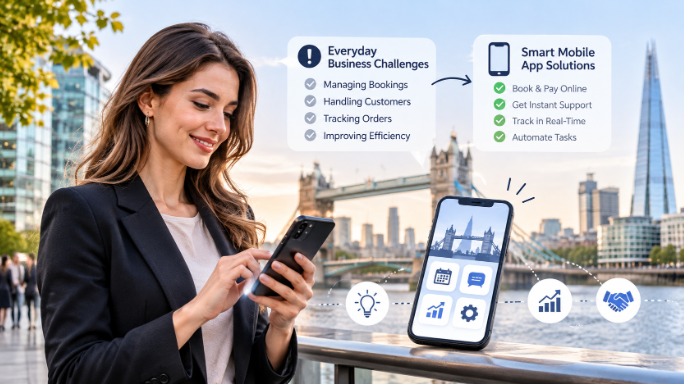
It’s an unglamorous story, and a useful one. A Mobile App Development Company in London will often tell you that the most successful business apps aren’t clever. They take an everyday headache that everyone has quietly accepted and make it disappear. Here’s how London businesses can find those headaches, and what to do once they have.
Why London’s Everyday Problems Are Particular
Every city has its frictions, and London’s shape the kind of app that earns its place on a customer’s phone.
Space and rent. Commercial property is expensive, and many independent businesses operate from small units with narrow margins. Wasted capacity, such as an empty chair, an unused table, or an unfilled class, hurts more here than in cheaper markets.
Transport and unpredictability. Customers travel across a sprawling city by Tube, Overground, Elizabeth line, bus, bike, and on foot. Delays, strikes, and engineering works mean arrival times are uncertain. Businesses that can adapt, with flexible rescheduling and clear communication, gain goodwill.
Dense competition. Within a short walk of almost any high street there are alternatives. A frustrating booking or payment experience sends customers to the next option without complaint.
Diverse and international customers. London’s population speaks hundreds of languages, and its visitors arrive from everywhere. Clear, well-localised experiences matter.
Regulation and expectations. UK GDPR and the Information Commissioner’s Office set the rules for personal data, and customers increasingly expect transparency about how their information is handled.
High digital baseline. Contactless payments, Apple Pay, and apps like Citymapper, Monzo, and Deliveroo (all born in or around London) have raised the bar for what smooth feels like.
Turning a Challenge Into an App Idea
A useful exercise is to list the recurring problems in your business and pair each with the simplest mobile answer. A few common pairs:
- Double-bookings and phone tag → live availability and instant confirmation.
- No-shows and late cancellations → deposits, reminders, and easy rescheduling.
- “Is it ready yet?” calls → status updates and notifications.
- Staff tied to the door → digital access codes or self-check-in.
- Customers unsure what’s in stock → live inventory by location with a click-and-collect option.
- Paperwork and forms → digital intake and e-signatures before arrival.
- Slow payment at the end → saved cards, Apple Pay, and pay-by-bank.
- Repeat questions about opening hours, directions, or policies → a single source of truth inside the app.
The studio owner’s list had three items: double-bookings, key handovers, and no-shows. Every feature in the app traced to one of them. Anything that didn’t solve a listed problem stayed out of version one.
Where This Works Across London’s Sectors
The same approach plays out differently by sector.
Hospitality. Restaurants, cafés, and bars across Shoreditch, Soho, Brixton, and beyond face no-shows and uneven demand. Reservations with deposits, waitlists that fill cancellations automatically, and pre-ordering during rushes protect thin margins. For venues near theatres, attractions, or transport hubs, timing-aware communication helps customers plan around the shows and trains they’re catching.
High-street retail. Independents and small chains compete with online shopping on convenience. Showing live stock, offering reserve-and-collect, and sending low-key updates about new arrivals bring people through the door. Markets such as Borough or Brick Lane benefit from simple tools that help vendors share locations, hours, and specials.
Health and wellbeing. Physiotherapists, dentists, osteopaths, and private clinics use apps for booking, reminders, intake forms, and secure messaging. Patients accustomed to the NHS App’s clarity expect similar simplicity from private providers.
Professional services. Accountants, solicitors, and consultants increasingly offer client portals for sharing documents, approving work, and tracking progress, which replaces long email threads and reduces repeated chasing.
Lettings and property management. Tenants reporting a leak or a broken boiler want to submit photos, see progress, and know when a tradesperson is coming. Landlords and agents benefit from a record of requests and responses.
Venues and culture. Galleries, theatres, studios, and community spaces use mobile ticketing, timed entry, and membership features, with access control that reduces the need for door staff.
Delivery and trades. Congestion charge zones, the Ultra Low Emission Zone covering all London boroughs since 2023, parking restrictions, and unpredictable traffic make arrival windows hard to guarantee. Live tracking and honest updates make customers more forgiving than silence does.
Payments and Open Banking
The UK has been a leader in Open Banking, which lets customers share bank data and make payments directly from their accounts with their permission. For businesses, pay-by-bank can reduce card processing fees and speed up settlement, though adoption varies by customer and sector.
For most everyday apps, the priority is simply to make payment effortless. Support Apple Pay and Google Pay, store payment methods securely with the customer’s consent, and make receipts and refunds easy to find. If your app touches regulated financial services, such as lending, payments on behalf of others, or holding funds, speak to specialists early, since Financial Conduct Authority rules may apply.
Privacy, Accessibility, and Trust
London customers notice when an app asks for more than it needs. A few good habits:
- Collect only what you need, and explain why in plain English.
- Ask for permissions in context, such as location when a feature needs it, not all at launch.
- Provide clear consent and control. Make it easy to see, export, and delete data in line with UK GDPR.
- Be honest about third-party tools, like analytics and advertising SDKs.
- Design for accessibility. Legible text, strong contrast, screen reader support, and straightforward navigation serve a wide range of customers and align with obligations under the Equality Act.
Trust is slow to earn and quick to lose, and in a competitive city it’s often the deciding factor.
Start Small, Prove It, Then Grow
Before committing to a full build, test the problem and the solution cheaply.
Try a manual version. If you suspect deposits would reduce no-shows, take them through a payment link for a month and measure the effect. If you think customers would use status updates, send them by text for a few weeks and see how people respond. A simple form, a shared calendar, or a messaging group can stand in for an app long enough to learn what matters.
When the manual process works but becomes a burden, you’ve found something worth automating. When customers don’t engage with the simple version, you’ve saved yourself the cost of building something unused.
Pick one measurable outcome in advance, such as fewer double-bookings, fewer calls, higher repeat bookings, or a lower no-show rate, and check it after launch.
What It Costs
Business owners deserve a realistic figure. Mobile App Development Cost in London varies with scope, platform, design, integrations, and the team you choose, and rates are generally higher than in most UK cities. A focused app for a single business, with booking or ordering, payments, notifications, and a simple admin tool, commonly runs from about £25,000 to £70,000. More complex products, such as multi-site operations, custom scheduling, integrations with several systems, or polished brand-led design, more often fall between £80,000 and £200,000 or more.
The biggest cost drivers are the number of platforms (starting with one is cheaper), integration with existing tools like your till, calendar, or accounting software, how custom the interface is, and how much backend logic is needed. Don’t forget running costs: hosting, maintenance, operating system updates, support, and app store fees. As a rule of thumb, budget a meaningful percentage of the build cost each year to keep the app healthy.
The most effective way to control spend is to narrow scope. Launch with the one problem you validated, learn from real use, and grow from there.
Questions to Ask Before You Commit
Whoever you choose to work with, a few questions separate teams who understand small-business realities from those who don’t.
- Which apps have you built for businesses like mine, and can I try them?
- How will the app connect to the systems I already use?
- What would you leave out of version one?
- Who maintains it after launch, and what does that cost?
- How will you handle personal data and UK GDPR requirements?
- What does success look like, and how will we measure it?
Concrete answers suggest experience. Vague reassurances usually don’t.
The Studio, a Year On
The Kentish Town studio is busier than it was. The paper diary is in a drawer. The owner spends his evenings at home, and bands appear at the door to a code that works. He estimates he’s recovered a few hundred pounds a month in deposits that used to evaporate as late cancellations, and he’s won back something harder to measure: the sense that the business runs without him standing at the door.
He doesn’t talk about the app as technology. He talks about it as the end of a series of small, daily irritations, for him and for the musicians who book rooms.
That’s the opportunity for London businesses. The best mobile apps rarely start with a grand idea. They start with an ordinary frustration that everyone has stopped noticing, and the willingness to fix it properly.