Searching for Sisal Flooring Near Me? A Buyer’s Checklist From First Sample to Final Installation
Typing “sisal flooring near me” into a search engine usually happens at a specific moment in a renovation. You have decided you like the look of natural fibres, you have perhaps seen sisal in a friend’s home or a magazine, and now you want to touch it, see it in your own light and get a realistic price. The search results will give you a list of nearby suppliers, but they will not tell you how to choose between them or what to ask once you walk through the door.
This article is a practical checklist for that stage. It walks through why buying locally matters for natural fibres in particular, how to sample properly, what a good measure and quote should include, how to assess an installer, and when sisal tiles or rugs might be a smarter option than wall-to-wall carpet. Wherever you live in Australia, the same principles apply.
Why Local Matters More for Natural Fibres
For many products, buying online from anywhere in the country is perfectly sensible. Natural fibre flooring is different for a few reasons.
First, texture and colour are difficult to judge on a screen. Sisal’s character comes from the play of light across the weave, and natural undyed tones shift noticeably between morning and afternoon light, or between a north-facing living room and a south-facing bedroom. Photos and monitors flatten those differences.
Second, sisal installation is a specialised skill. Because sisal is usually glued down, moves slightly with humidity and has visible weave patterns that need careful seam matching, the quality of the installer matters as much as the quality of the product. A supplier with established local installers who regularly work with natural fibres is a significant advantage.
Third, after-sales support is easier locally. If you have a question about cleaning a spill, a seam that needs attention or adding a matching rug later, being able to visit or call a nearby specialist is invaluable.
Step One: Shortlist Suppliers Thoughtfully
When your search for sisal flooring near you returns a list of businesses, look beyond proximity and star ratings. Some useful signals include:
- Specialisation. A business that focuses on natural fibres is more likely to stock a broad range of weaves and to give realistic advice about limitations, compared with a general carpet store that keeps a handful of sisal samples.
- Range of fibres. A supplier that offers sisal alongside seagrass, jute, coir and wool blends can recommend the right fibre for each room rather than steering you towards the only option they have.
- Installation capability. Ask whether installation is done by their own team, regular subcontractors or whoever is available. Ask how many natural fibre installations those installers complete each year.
- Rug-making capability. If a supplier can also bind sisal into custom rugs, you have more flexibility to mix fitted carpet and rugs across your home.
Step Two: Sample Like a Professional
Taking home samples is the single most valuable thing you can do before committing.
Ask for generous samples. A small swatch is useful for colour, but a larger piece gives a far better sense of how the weave reads across a floor. If larger samples are available on loan, take them.
View samples in each room. Place them on the floor where the carpet will go, not on a bench or a windowsill. Look at them morning, midday and evening, and with artificial lighting at night.
Walk on them barefoot. Sisal ranges from fairly smooth to distinctly coarse. If you or your family like to go barefoot, this test alone may change your choice of weave.
Test real-life scenarios. Slide a dining chair across a sample, let the dog walk over it, roll an office chair on it. Bolder, loopier weaves can snag; tighter weaves are more forgiving.
Ask to see an aged sample. Natural sisal mellows gently with light exposure. Seeing how a product looks after a few years helps set expectations.
Step Three: Get an Accurate Measure
A professional measure should be done on site by someone who understands natural fibres. Expect them to note:
- Room dimensions and shape, including alcoves, bay windows and built-in joinery.
- The direction of the weave and how seams will fall relative to light and traffic.
- Subfloor type and condition, including whether timber needs an underlayment or a concrete slab needs moisture testing.
- Doorway transitions, thresholds and heights relative to adjacent flooring.
- Stairs, landings and any particularly tricky details.
Because sisal is sold off rolls of fixed widths, the layout affects how much material is needed. A good measurer will plan seams to minimise waste while keeping joins out of high-traffic areas and away from main sightlines.
Step Four: Read the Quote Carefully
Quotes for sisal flooring can vary considerably, and the cheapest is not always the best value. A complete quote should clearly itemise:
- The carpet itself, priced per square metre or per linear metre of roll.
- Underlay, if a double-stick method is used.
- Adhesive and any primers.
- Subfloor preparation such as levelling, underlayment over boards or moisture treatment.
- Removal and disposal of existing floor coverings.
- Stair installation, which is usually priced separately.
- Transition strips and trims.
- Furniture moving, if required.
- Any stain-protection treatment offered.
If two quotes differ significantly, compare line by line. Often a lower price omits subfloor preparation that will later be added as a variation, or assumes an installation method that is less suitable for the product.
Step Five: Assess the Installer
It is entirely reasonable to ask about the person who will actually install your floor. Useful questions include:
- How long have you been installing natural fibre floor coverings?
- What installation method do you recommend for this product and this subfloor, and why?
- How long should the carpet acclimatise before fitting?
- How will seams be positioned and matched?
- What adhesive do you use, and is it a low-VOC option?
- Can I see photos of recent sisal installations, particularly stairs if I am having them done?
A confident, specific answer to each of these is a good sign. Vague responses, or a suggestion that sisal can be installed exactly like ordinary synthetic carpet, are worth noting.
Step Six: Consider the Alternatives to Wall-to-Wall
Sometimes the best answer to a search for sisal flooring is not wall-to-wall carpet at all.
Sisal tiles
Sisal carpet tiles are squares of sisal with a stable backing that can be laid in a grid. They have several advantages. A damaged or badly stained tile can be replaced individually rather than replacing a whole room. Tiles are easier to handle in apartments with narrow stairwells or lifts. They can be useful in home offices and studios where cabling or future reconfiguration is likely. The trade-off is a visible grid pattern and less of the seamless look of broadloom carpet.
Bound rugs
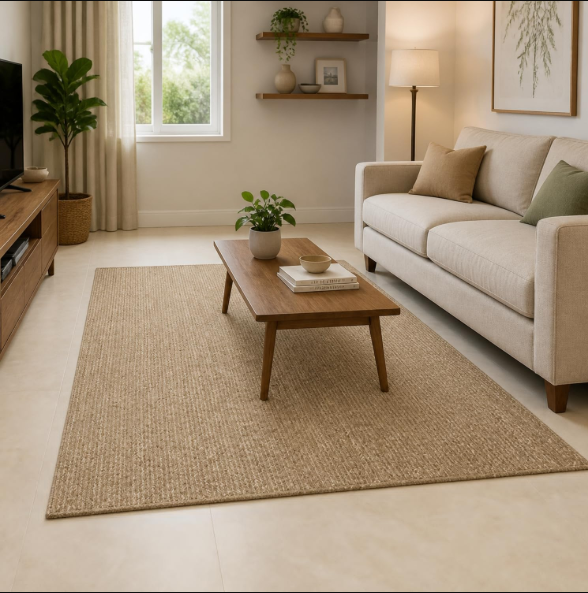
A large bound sisal rug laid over existing timber or concrete gives much of the same visual effect in a living area, while leaving the floor beneath intact and the rug portable. For renters, people planning to sell, or households with young children where accidents are likely, rugs offer flexibility that fitted carpet cannot.
A mixed approach
Many homes use wall-to-wall sisal in bedrooms, studies and stairs, with bound rugs in living and dining areas over hard floors. This balances comfort, practicality and cost.
Step Seven: Plan the Timing
Natural fibre floor coverings are often made to order or cut from imported stock, so lead times can vary. Allow for delivery, acclimatisation in the room for a day or two, installation, and adhesive curing time before heavy furniture goes back. If you are coordinating with painters, electricians or joiners, flooring usually goes in late in the schedule to avoid damage, but before skirting boards are finished and final cleaning takes place.
Also consider the season. Installing during extreme heat with the house closed up, or in a cold, unheated renovation site in winter, can affect how the carpet settles. Ideally, the home should be at normal living conditions during acclimatisation and installation.
Red Flags to Watch For
A few warning signs suggest you may want to keep looking:
- A supplier who claims sisal is waterproof or suitable for bathrooms and laundries.
- A recommendation to steam clean sisal.
- No mention of subfloor preparation or acclimatisation.
- Unwillingness to provide a written, itemised quote.
- Pressure to commit before you have taken samples home.
After Installation: Your First Few Months
Once the floor is down, keep the first few weeks gentle. Avoid dragging heavy furniture, use felt pads and furniture cups, and set up doormats at every external entry. Vacuum regularly with suction only. Keep the supplier’s care instructions handy and know who to call if a spill occurs. Natural sisal may show subtle tonal variation in the first months as it settles and adjusts to the light in your home. This is normal.
Conclusion
Searching for sisal flooring near you is the easy part. Choosing well depends on sampling thoroughly in your own home, getting a detailed measure and itemised quote, asking direct questions of the installer and considering whether tiles, rugs or a mix of formats might suit your household better than wall-to-wall carpet. A good local supplier will welcome those questions, explain the limitations of natural fibres honestly and help you match the right product to each room.
For readers in Victoria, Floorspace is a Melbourne natural fibre flooring specialist where sisal broadloom, rugs and natural sisal tiles can be compared, which may be a helpful first stop for homeowners across Melbourne and surrounding suburbs looking for sisal flooring nearby.